SUBSCRIBE | LOG IN TO THE FIRST FOOD CONNECTION HUB 
U.S. Breastfeeding Committee
  • USBC Membership
    • USBC Member Directory
    • Join USBC
    • Membership Benefits & FAQs
    • Membership Fee Schedules
    • Membership Interest Form & Affiliated Coalitions Directory Request Form
  • Policy & Actions
    • Constellation Work Groups >
      • Infant & Young Child Feeding in Emergencies Constellation
      • Disrupting Formula Marketing Constellation
      • Lactation Support Providers Constellation
      • Pasteurized Donor Human Milk Constellation
      • Workplace Support Constellation
    • Active Legislation
    • Breastfeeding Policy Map
    • Existing Legislation
    • Federal Policies, Programs, & Initiatives
    • PUMP Act >
      • The PUMP Act Explained
      • PUMP Act Implementation Resources
      • Know Your Rights-PUMP-Act--PWFA
    • Federal Appropriations for Breastfeeding
    • Take Action
    • Letters & Public Comments
  • Resources
    • USBC Directories >
      • USBC Member Directory
      • Affiliated Coalitions Directory
    • Breastfeeding References
    • Breastfeeding Resources for Parents
    • Breastfeeding In Emergencies >
      • Infant Formula Recall and Shortage
    • Constellation Developed Resources
    • Image Gallery Access
    • Lactation Support Provider Training Directory >
      • Lactation Support Providers Pathways
    • Learning Opportunities
    • Monthly Observances
    • State Breastfeeding Reports
    • USBC Data Survey
  • News & Events
    • Annual Conference
    • Events Calendar
    • National Breastfeeding Month
    • USBC in the Media
    • USBC News & Blogs
    • Weekly Wire Newsletter
  • About Us
    • About the USBC
    • Explaining our "Why"
    • Our Team
    • Job Opportunities
    • Board of Directors
    • USBC Committees
    • Diversity, Equity, and Inclusion
    • History
    • Community Agreements & Guidelines
    • Annual Reports
    • Ways to Give
    • Contact Us
  • USBC Membership
    • USBC Member Directory
    • Join USBC
    • Membership Benefits & FAQs
    • Membership Fee Schedules
    • Membership Interest Form & Affiliated Coalitions Directory Request Form
  • Policy & Actions
    • Constellation Work Groups >
      • Infant & Young Child Feeding in Emergencies Constellation
      • Disrupting Formula Marketing Constellation
      • Lactation Support Providers Constellation
      • Pasteurized Donor Human Milk Constellation
      • Workplace Support Constellation
    • Active Legislation
    • Breastfeeding Policy Map
    • Existing Legislation
    • Federal Policies, Programs, & Initiatives
    • PUMP Act >
      • The PUMP Act Explained
      • PUMP Act Implementation Resources
      • Know Your Rights-PUMP-Act--PWFA
    • Federal Appropriations for Breastfeeding
    • Take Action
    • Letters & Public Comments
  • Resources
    • USBC Directories >
      • USBC Member Directory
      • Affiliated Coalitions Directory
    • Breastfeeding References
    • Breastfeeding Resources for Parents
    • Breastfeeding In Emergencies >
      • Infant Formula Recall and Shortage
    • Constellation Developed Resources
    • Image Gallery Access
    • Lactation Support Provider Training Directory >
      • Lactation Support Providers Pathways
    • Learning Opportunities
    • Monthly Observances
    • State Breastfeeding Reports
    • USBC Data Survey
  • News & Events
    • Annual Conference
    • Events Calendar
    • National Breastfeeding Month
    • USBC in the Media
    • USBC News & Blogs
    • Weekly Wire Newsletter
  • About Us
    • About the USBC
    • Explaining our "Why"
    • Our Team
    • Job Opportunities
    • Board of Directors
    • USBC Committees
    • Diversity, Equity, and Inclusion
    • History
    • Community Agreements & Guidelines
    • Annual Reports
    • Ways to Give
    • Contact Us

uSBC News & Blogs

2023 archives
December
  • 12/4/2023: usbc stakeholder listening sessions: share your vision for achieving infant nutrition security
November 
  • 11/29/2023: USBC Membership meeting mission moment with dr. scott hartman
  • 11/22/2023: Reflections on Native American Heritage Month: a Conversation with kimberly moore-salas
  • 11/21/2023: 2023 Impact Report: breastfeeding policy priorities
  • 11/17/2023: USBC Interim EXECUTIVE DIRECTOR ANNOUNCEMENT
October
  • 10/30/2023: USBC Executive director transition announcement
September
  • 9/28/2023: using data to inform infant and young child feeding in emergency preparedness systems
  • 9/20/2023: Reviving identity caucuses at the usbc: we want to hear from you!
  • 9/19/2023: Reflecting on national breastfeeding month 2023 wins
August
  • 8/25/2023: FY24 appropriations: what recent senate bills mean for infant feeding
July
  • 7/28/2023: Fy24 appropriations: what the house and senate bills mean for infant feeding
  • ​7/25/2023: taking the time for celebration: the pump act and pwfa are law!
  • ​7/21/2023: news from the chair: change is good
march
  • 3/23/2023: fiscal year 2024 president's budget: what it means for the lactation field
  • 3/1/2023: renewing the usbc commitment to equity as we seek to grow the usbc membership network
february
  • ​2/16/2023: join the usbc welcome congress campaign!
  • ​2/15/2023: the u.s. breastfeeding committee launches the creating space scholarship
  • ​2/8/2023: open letter to congress: new research highlights critical need for strong policies to leverage the value of breastfeeding
january
  • ​1/12/2023: fy23 federal budget signed into law: what it means for infant feeding
  • ​1/6/2023: pump for nursing mothers act signed into law
2022 archives
december
  • 12/24/2022: pump for nursing mothers act will soon be signed into law
  • 12/8/2022: usda proposes new wic package
november
  • ​11/1/2022: the usbc membership steps into a new opportunity for connection: launching the first food connection hub & taking a mission moment with monica esparza
october
  • 10/27/2022: 2022 impact report: breastfeeding policy priorities
  • 10/24/2022: a closer look at the 2022 cdc breastfeeding report card
september
  • 9/29/2022: STATEMENT ON WHITE HOUSE CONFERENCE ON HUNGER, NUTRITION, AND HEALTh
august
  • 8/24/2022: fy23 appropriations: what the senate bills mean for infant feeding
  • 8/18/2022: a consideration of choice (in the absence of systemic supports)*
​july
  • 7/14/2022: fy23 appropriations: what the house bills mean for infant feeding
june
  • 6/24/2022: the senate failed to pass the pump act on wednesday. that hurts. but it doesn't mean the fight is over.
  • 6/2/2022: the four pillars of infant nutrition security in the united states
​may
  • 5/19/2022: infant formula recall and shortage: resources
  • 5/13/2022: calling your senator about the pump act is easy! here's how.
january
  • 1/26/2022: call for proposals for the 2022 conference!
  • 1/3/2022: impact report: 2021 breastfeeding policy priorities
​
2021 archives
DECEMBER  
  • 12/9/2021: 2020 state and territory breastfeeding reports now available!
  • 12/3/2021: join usbc on our equity journey​
november
  • 11/12/2021: 2020 usbc annual report released!​​​​
october​
  • 10/22/2021: protecting parents, babies, public health, employers, and the economy: a bipartisan case for the pump for nursing mothers act
  • 10/22/2021: pump for nursing mothers act passes with bipartisan support in u.s. house of representatives
  • 10/20/2021: breaking news: the pump act is going to the house floor for a vote this friday
september
  • 9/30/2021: reflections on national preparedness month and the pandemic
  • 9/28/2021: join the nationwide pump act call-in day
  • ​9/27/2021: the house is voting on the pump act this week. join the week of action.
  • 9/26/2021: pump act week of action partner toolkit
  • 9/10/2021: reflections on national breastfeeding month 2021: every step of the way
august
  • 8/24/2021: 8 questions answered by the usbc policy team
july
  • 7/29/2021: Cdc awards usbc a five-year grant to coordinate a national approach to improve the infant feeding landscape
  • 7/22/2021: fiscal year 2022 house agriculture and dhs appropriations reports released
  • 7/16/2021: fiscal year 2022 house labor-hhs appropriations report released
may
  • 5/24/2021: reclaiming our tradition: aanhpi breastfeeding week 2021
2020 archives
AUGUST
  • 8/31/2020: celebrating #bbw20: revive. restore. reclaim!
  • 8/21/2020: native breastfeeding week is over, but the work continues
  • ​8/7/2020: happy national breastfeeding month! we are many voices united #nbm2020

The Four Pillars of Infant Nutrition Security in the United States

6/2/2022

0 Comments

 
Picture
Amelia Psmythe Seger, Deputy Director
Throughout its 22-year history, the U.S. Breastfeeding Committee has been working towards the policy, systems, and environmental changes that build a landscape of breastfeeding support.
​
The catastrophic infant formula shortage demonstrates the value of this work and the need to build a robust infrastructure for infant nutrition security in the U.S. that holds all families in care.
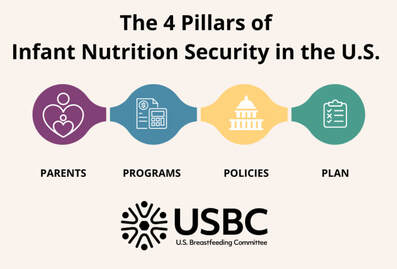
This infrastructure includes four pillars: Parents, Programs, Policies, and a Plan for emergencies.
Picture

Parents:

Parents are critical stakeholders in infant nutrition security. The Parents pillar includes people of all races, genders, caregiving roles, routes to parenthood, immigration status, religious or political views, and infant feeding methods. Everyone who loves and cares for a young child belongs. Welcome.

Parents deserve the full support of a robust national infant nutrition security infrastructure. Without it, many are forced onto painful and difficult paths of infant feeding and care. The U.S. needs equitable programs, policies, and a plan for emergencies that centers on the most impacted.

Parents and caregivers whose infants rely on formula are the highest priority right now. They need help finding formula, advice on switching between formulas, reassurance that reliable supplies are on the way, and an answer to the question: what should I feed my baby if I cannot find formula?  With appropriate caution, the American Academy of Pediatrics (AAP) published an article on what to feed babies of different ages and situations in an extreme emergency (such as this). Babies under six months should truly only consume human milk or infant formula. In considering very short-term alternatives, the stakes are so high that a physician should monitor the baby.

Parents who are breastfeeding or feeding human milk are in anguish right now, too. Many are feeling pressure to share their milk without acknowledgment of how hard this society has made it to establish and maintain milk supply. Few families have access to lactation support providers, paid family leave, and workplace accommodations to pump breast milk during the workday. In this context, many turn to formula as their backup plan, and it is very scary for them to see that their safety net is in tatters. To answer questions related to human milk, the Academy of Breastfeeding Medicine (ABM) published a guide. This ABM guide addresses pregnancy, low milk supply, re-lactation, options for donation or safe milk sharing, and healthcare guidance and training.
​
Additional burdens or blame should never be placed on the families and caregivers whose hands are literally full of babies and toddlers. When capacity allows, however, the collective potential power of parents is significant. Consider if parents insisted on being at the table with the commercial milk formula industry, playing a role in ensuring industry quality, safety, and ethics. They are key stakeholders, after all, so this should be encouraged. Parents could also insist the U.S. enhance our nonprofit milk banking system to ensure an affordable, plentiful donor milk supply for medically fragile infants and those whose parents cannot or do not wish to breastfeed. This would diversify the infant food supply and provide parents with more options.

Programs:

Federal programmatic funding needs to be expanded considering setbacks caused by the pandemic, including the current infant formula shortage.

Federal funding supports quality improvement investments to implement maternity care best practices in hospitals, especially while recovering from pandemic-induced breakdowns in those settings.

Expansion of this funding supports state and community efforts to advance care coordination and strengthen lactation support through policy, systems, and environmental change interventions to reduce or eliminate breastfeeding disparities along the fault lines of income and race.

Federal investments enhance and deepen partnerships to integrate infant feeding and lactation support services into emergency response systems and food security programs during acute disasters and prolonged public health crises.
​
This funding supports critical national monitoring and public reporting activities, including annual analysis of the National Immunization Survey (NIS), administration of the bi-annual Maternity Practices in Infant Nutrition and Care (mPINC) Survey, bi-annual production of the National Breastfeeding Report Card, and administration of the longitudinal Infant Feeding Practices Study. All of which is especially needed in light of recent updates to the Dietary Guidelines for Americans, which, for the first time, provides nutritional guidance for infants and toddlers.

Policies:

Due to major policy gaps, families face obstacles that make it difficult or impossible to start or continue breastfeeding. Policymakers must choose to prioritize the policies and investments for infant food security so that we never find ourselves in this situation again.

Critically needed policy solutions are waiting for Congressional action:

  • Establish a national paid family and medical leave program. The FAMILY Act (S. 248/H.R. 804) would ensure that families have time to recover from childbirth and establish a strong breastfeeding relationship before returning to work.
  • Ensure all breastfeeding workers have time and space to pump during the workday. The Providing Urgent Maternal Protections (PUMP) Act (S. 1658/H.R. 3110) would close gaps in the Break Time for Nursing Mothers Law, giving 9 million more workers time and space to pump. Contact your legislators about the PUMP Act!
  • Invest in the CDC Hospitals Promoting Breastfeeding program by increasing funding to $20M in FY2023. This funding helps families start and continue breastfeeding through maternity care practice improvements and community and workplace support programs. 
  • Create a formal plan for infant and young child feeding in emergencies. The DEMAND Act (S. 3601/H.R. 6555) would ensure the Federal Emergency Management Agency can better support access to lactation support and supplies during disasters. Contact your legislators about the DEMAND Act!

Additional areas for policy development

The U.S. has not regulated the marketing practices of the commercial milk formula industry, unlike 70% of the world, which has implemented at least some part of the WHO's International Code of Marketing of Breast-Milk Substitutes. In the absence of regulation, these marketing practices are predatory.
​
Diversify the nation's production of infant formula. Plainly it is a mistake to allow 42% of the infant formula in this country to be produced not only by one company but by one factory of that company. Infant formula companies are part of an infant food security system, but we don't have to be so dependent on that industry.

Enhance the national network of nonprofit donor milk banks. Support innovative partnerships across existing structures, taking a cue from a national model such as what exists in Brazil. Consider: Red Cross has the infrastructure to support donor screening; WIC offices or community health clinics could be donor drop-off sites; more hospitals could provide space and equipment for donor milk processing and distribution, as some have done. Models exist to create an affordable and plentiful alternative to commercial milk formula when a parent's own milk is not available.

Plan:

All nations should have a robust plan for infant and young child feeding in emergencies that includes three phases: preparedness, response, and resiliency. The USBC-Affiliated Infant & Young Child Feeding Constellation has published a Joint Statement on Infant & Young Child Feeding in Emergencies (IYCF-E) in the U.S. context.
Emergency preparedness includes building a lactation support provider directory and a system to track the inventory of national resources such as infant formula.

Emergency response for infants, young children, and their families must include priority shelter, trauma-informed care, lactation support providers in every community; access to breast pumps, and milk storage and cleaning supplies; non-branded infant formula, clean water, bottles, and cleaning supplies.
​
Emergency resilience includes trauma-informed care that centers on the needs of communities that have been historically undersupported, and disproportionately impacted in emergencies.
Every system is perfectly designed to get the results it gets. The insufficient system we've had, led to this crisis. It was predictable, and thus it was preventable.
​
Now that there’s a mass mobilization of activity – from neighbors driving many miles to find spare formula tins, to the President invoking the defense production act – we must collectively build the resiliency to support a community during a flood, a region during a power outage, or a nation during a pandemic and supply chain crisis. We will get through this because we must. Together we must ensure we build an infant nutrition security system worthy of parent's trust.  
0 Comments

Your comment will be posted after it is approved.


Leave a Reply.

    Author

    Write something about yourself. No need to be fancy, just an overview.

    Archives

    October 2025
    September 2025
    August 2025
    April 2025
    December 2024
    October 2024
    September 2024
    August 2024
    July 2024
    June 2024
    May 2024
    April 2024
    December 2023
    November 2023
    October 2023
    September 2023
    August 2023
    July 2023
    March 2023
    February 2023
    January 2023
    December 2022
    November 2022
    October 2022
    September 2022
    August 2022
    July 2022
    June 2022
    May 2022
    January 2022
    December 2021
    November 2021
    October 2021
    September 2021
    August 2021
    July 2021
    May 2021
    August 2020

    Categories

    All

    RSS Feed

Copyright U.S. Breastfeeding Committee.  All Rights Reserved.
1629 K Street NW, Suite 300 | Washington, DC 20006
Phone: (773) 359-1549 | [email protected] | sitemap
QuestionPro's survey software plays a major role in helping us keep in touch with our alumni, volunteers, donors, employees, and other affiliates. Surveying them has helped strengthen our relationship.

Picture